
Google Cloud AI Gemini 4 Argon Thailand AI
Gemini 4 Argon: What Google’s New AI Model Means for Businesses
Gemini 4 Argon explained for businesses in Thailand and Singapore, including Gemini Enterprise, AI agents, security, implementation and platform comparisons.
Oliver Machwirth · 05 October 2026 · 4 min read
TL;DR
Gemini 4 Argon signals a shift from short AI interactions toward long-running, multi-step work. For businesses in Thailand and Singapore, the opportunity is not simply better answers. It is AI agents that can research, reason, use tools and execute work across finance, operations, software, research and cybersecurity. The companies that benefit most will be the ones that combine stronger models with good data access, clear permissions, human approval points and practical governance.
Google has introduced Gemini 4 Argon, its latest frontier AI model, and the announcement gives us a strong indication of where enterprise AI is heading next.
The biggest shift is not simply that Argon is more intelligent. It is that models are becoming capable of working on much longer, more complex tasks with less human intervention.
For organisations evaluating enterprise AI in Thailand or Singapore, that changes the question. Instead of asking whether AI can help with one task, leaders can start asking which business processes could be delegated to an AI agent across several connected steps.
From AI assistants to AI workers
Most companies still use AI in relatively short interactions: writing an email, summarising a document, analysing data, generating a presentation or helping with code.
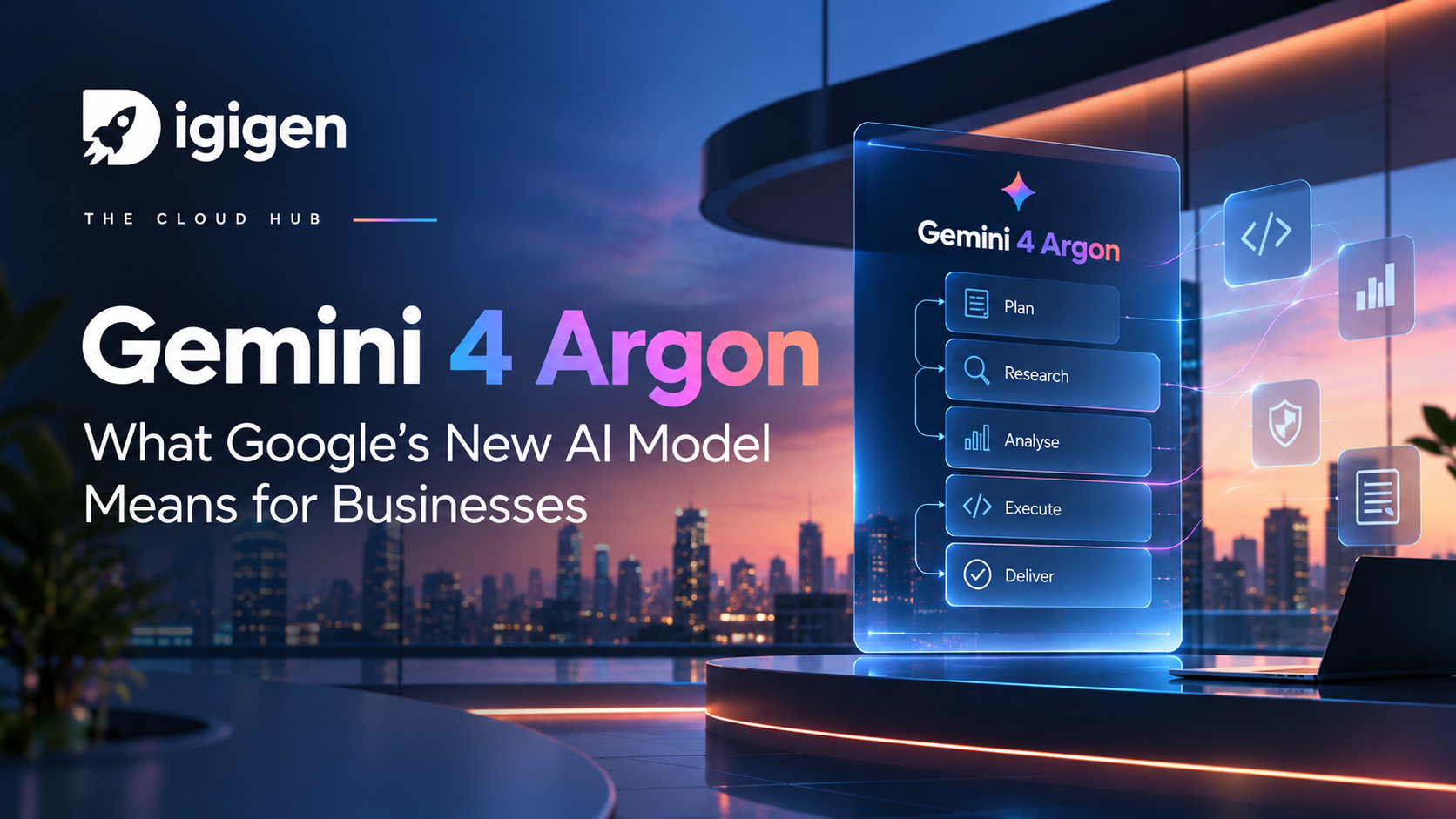
The next generation of AI systems is increasingly designed to work differently. Instead of answering one prompt, an agent may receive an objective and work through dozens or hundreds of individual steps to complete it.
A real business workflow might look like this
Review our customer pipeline, identify stalled opportunities, research the accounts, recommend the next action and prepare personalised follow-up messages.
That is a chain of interconnected tasks. The more reliably AI models can maintain context and reasoning across those chains, the more useful AI agents become.
Google says Argon can sustain much longer outputs than the previous generation. The significance is less about producing very long text and more about giving the model more room to plan, use tools, evaluate intermediate results and continue working through complicated problems.
Where Gemini 4 Argon could matter most
Finance
Analyse financial documents, investigate anomalies, prepare management reports and conduct multi-step research.
Legal & compliance
Review contracts, compare clauses, research relevant information and prepare structured drafts for human review.
Software development
Debug applications, analyse large codebases, test fixes and complete multi-step engineering tasks.
Operations
Connect information across CRM, ERP, email and databases and complete workflows that previously required several manual steps.
Research
Work across large collections of documents and other sources to produce deeper analysis and decision-ready outputs.
Cybersecurity
Investigate vulnerabilities, correlate evidence and support remediation across code, infrastructure and threat intelligence.
Gemini 4 Argon is not the same thing as Gemini Enterprise
This distinction matters for search, procurement and deployment. Gemini 4 Argon is a model. Gemini Enterprise is an enterprise AI and agent platform.
Google describes Gemini Enterprise as a platform for enterprise search, conversational assistance and AI agents, with permissions-aware access to company information and connectors to Google Workspace, Microsoft 365, HubSpot, Jira, SharePoint, ServiceNow and other systems.
If you are evaluating the broader platform rather than only the model, see our Gemini Enterprise Thailand guide. The important enterprise question is not simply which model scores highest. It is how the model is connected to your data, users, applications, permissions and governance.
Gemini 4 Argon in Thailand: what businesses should know
Thailand is a particularly interesting market for enterprise AI because many organisations are already standardising on Google Workspace, Google Cloud or Microsoft 365, but operational processes still rely heavily on email, spreadsheets, shared drives, ERP systems and manual approvals.
That means the biggest opportunity is often not a standalone chatbot. It is an AI agent that can work across the systems employees already use.
What Thai companies should evaluate first
- Data location and access: which systems contain the information an agent needs?
- PDPA: what personal or sensitive information may be exposed during agent workflows?
- Approval points: which actions can run automatically and which need human confirmation?
- Local billing and procurement: whether the deployment can be purchased and supported locally in THB.
- Thai-language workflows: where Thai-language documents, customer messages or internal knowledge need to be understood correctly.
For companies already using Google Workspace, it is worth looking at both the AI functionality built into Workspace and the broader agent capabilities available through Gemini Enterprise. You can also review our Google Workspace Thailand page for local licensing and deployment options.
The best first project is usually a workflow with clear inputs, a measurable manual cost and a defined human owner. Examples include sales follow-up, invoice review, procurement research, policy lookup, internal knowledge search or management reporting.
Gemini 4 Argon in Singapore: where the enterprise opportunity is strongest
Singapore companies often have a different starting point. Regional headquarters tend to operate across several markets, use a wider mix of SaaS platforms and have more formal security, governance and procurement processes.
That makes cross-system orchestration particularly valuable. Google currently highlights enterprise connectors for systems including Microsoft 365, SharePoint, HubSpot and Jira, which means Gemini Enterprise can sit above a mixed application environment rather than requiring an all-Google stack.
Regional HQ research
Aggregate information across markets, business units and document repositories for management decisions.
Revenue operations
Connect CRM, email and meeting information to surface risks, next actions and account intelligence.
Governed automation
Automate repetitive workflows while preserving approval gates, identity controls and auditability.
For Singapore organisations evaluating productivity suites at the same time, our Google Workspace Singapore page covers local implementation, while our Google Workspace vs Microsoft 365 Singapore comparison helps frame the broader platform decision.
For regional teams, the business case is strongest when one agent can work across tools employees already use rather than forcing a major application migration before value can be created.
Gemini Enterprise vs Microsoft Copilot: which direction makes sense?
There is no universal winner. The right choice depends on where your users, documents, workflows and governance already live.
| Consideration | Gemini Enterprise | Microsoft Copilot ecosystem |
|---|---|---|
| Best fit | Google Cloud / Workspace and mixed SaaS environments | Microsoft 365, Teams, SharePoint and Azure-heavy environments |
| Agent building | Workflow Builder, Agent Studio, ADK and open agent standards | Copilot Studio and Microsoft Power Platform ecosystem |
| Cross-platform data | Strong focus on enterprise connectors and permissions-aware search | Strongest when data and workflows already sit inside Microsoft services |
| Decision factor | Agent flexibility and cross-system orchestration | Deep Microsoft productivity integration |
For Thailand specifically, we also maintain a Google Workspace vs Microsoft 365 Thailand comparison. Because Digigen works across both ecosystems, our recommendation is to start from the workflow and governance requirements rather than from the logo on the product.
Security for AI agents is becoming just as important as capability
As AI systems gain more access to company applications and data, new attack surfaces emerge. Prompt injection is one example: an agent browsing documents, websites or emails could encounter malicious instructions designed to manipulate its behaviour.
That is why enterprise deployments should be designed around permissions, identity, approval points, auditability and monitoring from the beginning.
Minimum controls for a production AI agent
- Permissions scoped to the agent's actual job
- Clear rules for sensitive data and personal data
- Human approval before high-impact actions
- Audit logs and traceability
- Prompt-injection and untrusted-content safeguards
- Monitoring for abnormal behaviour or cost
- A named business owner for each production workflow
A practical 30-day Gemini Enterprise pilot
Week 1
Choose one measurable workflow
Map the current process, manual effort, data sources and success metric.
Week 2
Connect data and permissions
Define which systems the agent can read or write and where human approval is required.
Week 3
Build and test
Run the workflow on real examples, capture failures and tighten prompts, tools and controls.
Week 4
Measure and decide
Compare time saved, quality, risk and adoption against the baseline before scaling.
The bigger picture
Gemini 4 Argon is another signal that the AI industry is moving rapidly from chatbots toward autonomous AI systems capable of executing real work.
The competitive advantage will increasingly come from how organisations connect models such as Gemini, ChatGPT, Claude and Microsoft Copilot with their existing data, applications and business processes.
If your goal is workflow automation rather than only model access, see The Agentiv by Digigen, where we focus specifically on AI agents and automation across Thailand and Singapore.
DIGIGEN + THE AGENTIV
Turn AI capability into a working business system
Digigen helps organisations in Thailand and Singapore evaluate Gemini Enterprise, Google Workspace, Microsoft 365 and AI agent use cases. The Agentiv focuses on workflow automation and agent design across the tools your teams already use.
If you want to identify the first one or two workflows worth piloting, we can map the process, data, governance and expected value before you commit to a large rollout.
Talk to Digigen about Gemini EnterpriseFrequently asked questions
What is Gemini 4 Argon?
Gemini 4 Argon is Google's frontier AI model designed for longer-running, multi-step work across software engineering, enterprise knowledge tasks, cybersecurity and other complex workflows.
Is Gemini 4 Argon the same as Gemini Enterprise?
No. Gemini 4 Argon is a model. Gemini Enterprise is Google's enterprise AI and agent platform for search, assistants, connectors and governed AI agents across company data and applications.
Can businesses in Thailand use Gemini Enterprise?
Yes. Thai organisations can evaluate Gemini Enterprise and related Google AI services, but deployment should account for local procurement, PDPA, permissions, data access and Thai-language workflows.
Can businesses in Singapore use Gemini Enterprise?
Yes. Singapore organisations can use Gemini Enterprise for enterprise search, assistants and AI agents, including mixed environments that connect Google Workspace, Microsoft 365 and third-party business systems.
What are the best first AI agent use cases?
Good first use cases have clear inputs, a measurable manual cost and a defined business owner. Examples include sales follow-up, internal knowledge search, invoice review, management reporting, research and operational handoffs.
How does Gemini Enterprise compare with Microsoft Copilot?
Gemini Enterprise is particularly strong for Google Cloud, Workspace and cross-system agent orchestration. Microsoft Copilot is strongest in Microsoft 365, Teams, SharePoint and Azure-heavy environments. The right choice depends on your existing systems and the workflows you want to automate.
What should companies prepare before deploying autonomous AI agents?
Permissions, data access, human approvals, audit logging, monitoring, prompt-injection protection and a named business owner should be defined before agents are given broad access to production systems.
Sources include Google Cloud documentation for Gemini Enterprise agents, connectors and Workflow Builder, plus Google's Gemini 4 Argon announcement. Product availability, benchmark results and pricing can change, so confirm current terms before making purchasing or deployment decisions.