
Gemini 4 Carbon is available: what developers should test before switching
Google’s Gemini 4 Carbon targets difficult, multi-step work. Explore access routes and a practical way to evaluate quality, latency and cost on a sample task.
Oliver Machwirth · 25 November 2026 · 4 min read
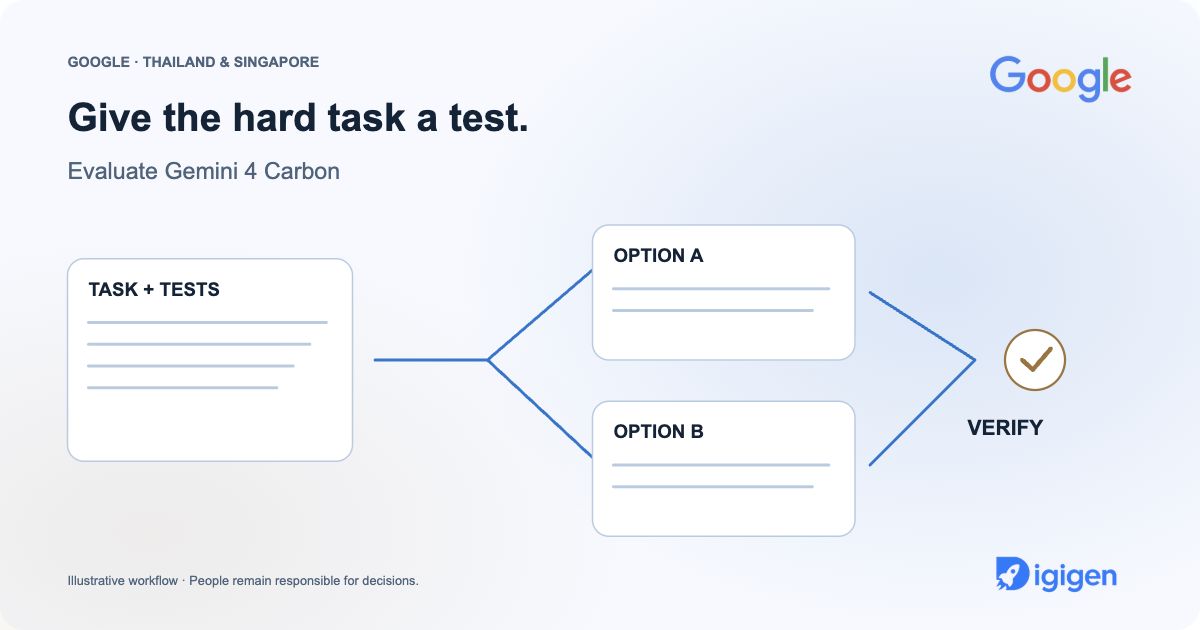
Original editorial illustration above. Not a product screenshot.
What Google announced
Google positions Carbon for demanding, multi-step coding, debugging and research, while saying Argon remains suitable for most software engineering and knowledge work. Carbon can spend more tokens on exploration and verification. Read Google’s model announcement.
The developer announcement identifies paid API access through Google AI Studio and Android Studio, plus routes for eligible Google AI Ultra subscribers. This is separate from assuming that a model is included in a company’s Workspace subscription. Check the developer access announcement.
Choose a task that exposes a real difficulty
Our suggested experiment: take a small, non-sensitive application defect for which you know the expected behaviour. Supply a minimal example, a failing test and a clear description of what should remain unchanged. Ask each candidate model to explain the cause, propose a correction and identify what it could not verify.
Keep the inputs and acceptance criteria the same. Otherwise you risk comparing two different instructions rather than two approaches to the same problem.
Measure more than a convincing explanation
Run the proposed tests and inspect the change. Did it solve the original problem? Did it introduce a new dependency or alter an unrelated feature? Record the time you spent reviewing and correcting the result as well as the generation time.
Our evaluation sheet would include correctness, unexpected changes, latency and actual usage cost. Leave an unknown value blank with a reason. Do not convert missing telemetry into zero cost or assume a longer response represents deeper accuracy.
Keep the first run inside a controlled boundary
Use a sample repository or a prepared copy. Keep credentials, customer records and deployment access out of the exercise. A model evaluation does not need permission to change production.
For teams working across Thailand and Singapore, add one example of the language, formatting or domain terminology your application uses. That checks a relevant requirement rather than relying only on a general demonstration.
Keep the model that fits the job
You may find that one model is useful for a difficult investigation while another remains appropriate for routine tasks. Document that decision so another developer can reproduce it. Re-run a small acceptance set when the model or application changes.
For context on the earlier release, read Digigen’s Gemini 4 Argon explainer. To connect the evaluation with a broader implementation, explore The Agentiv. There is no need to switch a working system simply because a new model has arrived.
Quick questions
Does this announcement upgrade every Workspace account?
No. Model access and Workspace feature entitlements are separate questions. Check the current product and account requirements.
Should every task use Carbon?
Not automatically. Compare it against the current approach on a representative task, including correctness, review effort, time and usage cost.
Official sources and dates
Checked 14 November 2026. Rollout descriptions reflect the announcements linked here; account availability may differ. Exercises and recommendations are Digigen editorial guidance.